What makes a luxury home in Aurora feel truly distinctive? It is not just square footage or a long driveway. In Aurora, luxury is often shaped by architecture, streetscape, and how a home fits its setting. If you are buying, selling, or simply watching the market, understanding these design patterns can help you read value more clearly. Let’s dive in.
Aurora Luxury Has More Than One Look
One of the most useful ways to think about Aurora’s luxury housing is as a mix of architectural languages rather than one signature style. Town planning and heritage documents point to three broad patterns: heritage traditionals in the old core, estate-scale homes on edge and rural-fringe parcels, and newer custom builds in planned neighbourhoods with strong design guidance.
That matters because buyers are often choosing more than a house. You may be choosing a setting, a level of design control, and a certain relationship between the home, the lot, and the street. In Aurora, those differences can shape both daily living and long-term appeal.
Heritage Styles in Old Aurora
The clearest heritage pocket in Aurora is the Northeast Old Aurora Heritage Conservation District. In this area, the Town requires approval for exterior alterations, new construction, and demolition within the district. Those decisions are weighed against the Heritage Conservation District Plan, the Official Plan, provincial policy, and national conservation standards.
For you as a buyer or seller, that means character is not left to chance. The public realm and visible built form are carefully protected, which helps preserve the architectural identity that draws people to this part of town.
Key Heritage Influences
Aurora’s self-guided heritage tour highlights several styles that help define the old core, including:
- Second Empire
- Edwardian
- Italianate
- Gothic
These are not abstract labels. In Northeast Old Aurora, they are visible at street level along areas such as Wells, Centre, Spruce, Catherine, Fleury, Maple, and Yonge streets.
Why Heritage Character Stands Out
In this part of Aurora, architectural character is especially legible. You can often notice the historic detailing, the rhythm of the streetscape, and a stronger sense of continuity from one property to the next.
The Town also notes that every tree in the district is considered a heritage asset. That detail says a lot about how Aurora approaches this area. The value is not only in the homes themselves, but also in the broader setting that frames them.
Estate Homes on Aurora’s Edges
Not every luxury buyer in Aurora wants a heritage home or a tightly guided subdivision setting. Some are drawn to estate-residential areas where privacy, separation, and landscape play a larger role.
In Aurora, this estate feeling is tied less to one decorative style and more to lot pattern and siting. A Town planning report for 14086 Yonge Street describes the surrounding area as predominantly low density and estate residential on a site of about 0.98 acres. Aurora’s zoning by-law also includes an Estate Residential zone that permits detached dwellings.
What Defines the Estate Feel
The premium in these areas often comes from features such as:
- Greater separation between homes
- More spacious lots
- Stronger landscape presence
- A slower transition between urban and rural character
If you are comparing luxury options in Aurora, this is an important distinction. A home may feel prestigious because of its architecture, but it may also feel prestigious because of the amount of breathing room around it.
Where You See It Most
The southern and eastern edge parcels of Aurora, including areas associated with Yonge Street South and St. John’s Sideroad, are where the estate-residential feeling is often strongest. These locations are useful to keep in mind if your priority is privacy, a more expansive setting, or an acreage-like atmosphere within Aurora’s broader luxury market.
Contemporary Custom Homes in Newer Areas
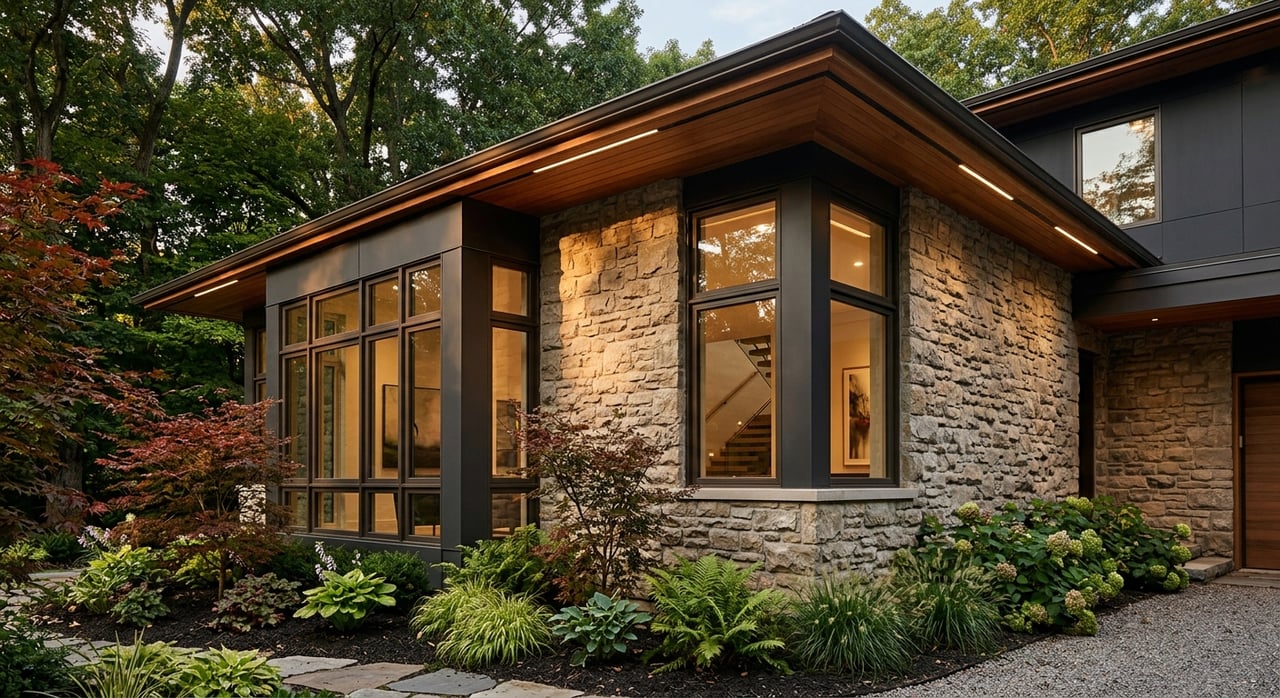
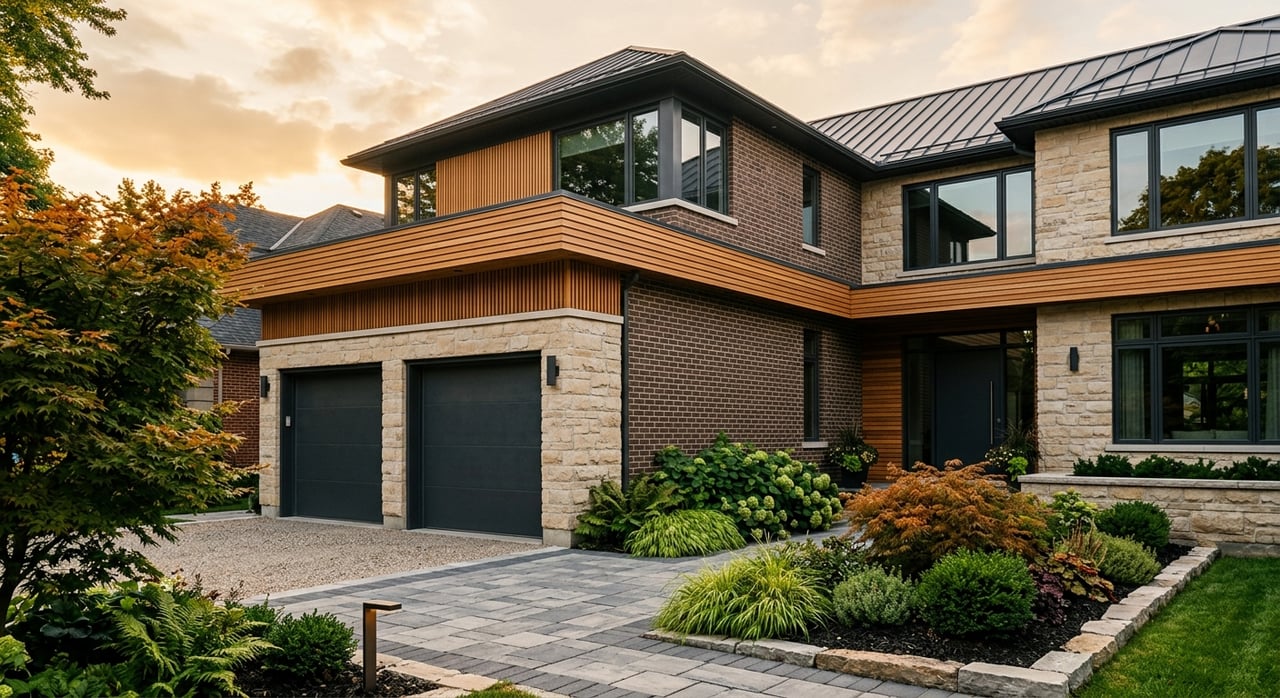
Aurora’s newer luxury homes often do not go fully modern. Instead, many blend traditional massing with contemporary details, creating a more transitional look that feels current without breaking too sharply from the surrounding streetscape.
The Archerhill Court urban design brief offers one of the clearest official examples of this newer luxury direction. The Town says contemporary design expressions are encouraged there, and flat roofs can be permitted where appropriate. At the same time, garages should complement rather than dominate the street presence.
Design Features Shaping Newer Luxury Homes
The Archerhill Court guidance points to several details that help define Aurora’s contemporary custom aesthetic:
- Large windows
- Recessed or flush garages
- Brick, stone, fibre-cement siding, and stucco
- Balanced massing
- Careful rooflines
- High-quality façades
These features are especially telling because they show what Aurora values in newer development. The goal is not simply visual impact. It is a controlled, polished streetscape where the architecture feels intentional.
Archerhill as a Local Example
The Archerhill Court site is located at the northwest corner of Bayview Avenue and Vandorf Sideroad and covers about 12.3 hectares. The Town describes the surrounding area as primarily residential, with single-detached lots, traditional architectural styles, low-pitched roofs, and brick and stone as dominant materials.
The proposed subdivision is designed as an enclave of primarily single-detached lots organized around an internal ring road. For luxury buyers, this type of planning can signal consistency, design oversight, and a curated neighborhood feel.
Planned Neighbourhood Design Matters
Aurora’s planning framework shows that luxury value is often tied to how a home fits the street and setting. This comes up again and again in local policy, whether the context is heritage preservation, infill, or newer residential planning.
In practical terms, Aurora is not just protecting house style. It is protecting compatibility, proportion, and streetscape quality.
Bayview Northeast and Wellington East
The Bayview Northeast Area 2B secondary plan helps explain how this works in newer planned areas. The plan envisions a primarily low-intensity residential community, with a multi-use corridor along Wellington Street East supported by a high-quality streetscape.
It also allows low-medium density housing forms such as single-detached, semi-detached, and townhouse homes, with building heights that should generally not exceed three storeys in the low-medium density area. For you, the takeaway is that the Town is guiding not just growth, but the visual and spatial experience of that growth.
Stable Neighbourhoods and Infill
Aurora also identifies several stable neighbourhoods, including Aurora Heights, Regency Acres, Temperance Street, and Town Park. The Town says these areas generally contain established, low-rise residential dwellings, and its guidelines are meant to shape infill and additions in ways that respect existing character.
Those guidelines address practical design elements such as lot size, setbacks, building height, garage width, landscape treatment, and front elevation treatment. This is another reminder that in Aurora, luxury appeal is often strengthened by restraint and compatibility, not size alone.
What Buyers Should Watch For
If you are shopping for a luxury home in Aurora, it helps to start with the setting before the finishes. The town’s documents suggest three very different experiences, each with its own kind of value.
You might be drawn to:
- Northeast Old Aurora for protected architectural character and a heritage-rich streetscape
- Edge and rural-fringe parcels for privacy, separation, and a stronger landscape presence
- Newer custom enclaves for polished materials, design control, and a cohesive street experience
When you understand which setting you prefer, the home search becomes more focused. You are not just comparing properties. You are comparing the planning logic and architectural story behind them.
What Sellers Can Highlight
If you own a luxury home in Aurora, your property’s architectural context may be one of its strongest selling points. Buyers at the high end are often paying close attention to more than interior upgrades. They may also care about the street presence, the lot relationship, and how protected or curated the setting feels.
That means your positioning should be specific. A heritage home in Northeast Old Aurora should not be marketed the same way as an estate-style property near Aurora’s edge, and neither should be framed like a newer custom home in a planned enclave.
Clear storytelling around architecture, setting, and design intent can help buyers understand what makes your property distinctive. In a nuanced market like Aurora, that clarity matters.
Why Aurora’s Luxury Market Feels Refined
What makes Aurora stand out is not that every luxury home looks the same. It is the opposite. The town offers a layered mix of preserved heritage architecture, traditional detached homes, and contemporary custom forms.
At the same time, local planning documents show a consistent standard underneath that variety. Across heritage districts, stable neighbourhoods, and newer planned communities, Aurora places real emphasis on fit, balance, and streetscape quality. That is a big part of why the town’s luxury market feels considered rather than random.
If you want help interpreting how architecture, lot context, and neighborhood design influence value in Aurora, working with a local advisor can save you time and sharpen your decisions. To explore your next move with a boutique, white-glove approach, connect with Lisa Colalillo.
FAQs
What architectural styles define luxury homes in Aurora?
- Aurora luxury homes are shaped mainly by heritage traditionals in Northeast Old Aurora, estate-style detached homes in low-density edge areas, and newer custom homes that blend traditional massing with contemporary details.
What is the Northeast Old Aurora Heritage Conservation District?
- It is Aurora’s protected heritage core, where exterior alterations, new construction, and demolition require Town approval and are reviewed against heritage and planning policies.
Where can you find heritage architecture in Aurora?
- The strongest concentration is in Northeast Old Aurora, including streets such as Wells, Centre, Spruce, Catherine, Fleury, Maple, and Yonge, where styles like Edwardian, Second Empire, Italianate, and Gothic are highlighted by the Town.
What makes estate homes in Aurora different?
- Estate homes in Aurora are defined more by low-density setting, lot separation, landscape, and privacy than by one specific architectural style.
What design features appear in Aurora’s newer custom luxury homes?
- Official design guidance points to large windows, recessed or flush garages, balanced massing, careful rooflines, and materials such as brick, stone, fibre-cement siding, and stucco.
Which Aurora areas reflect newer planned luxury development?
- Areas connected to Bayview Avenue, Vandorf Sideroad, Archerhill Court, and Bayview Northeast show the Town’s approach to newer residential design with strong streetscape and compatibility standards.
Why does Aurora’s planning framework matter to luxury buyers and sellers?
- It helps shape how homes fit their streets and settings, which can influence architectural character, neighborhood consistency, and the overall appeal of a luxury property.